What a poignant novel!
Can the horrors of war or any traumatic experience be glossed over to live a "normal" life?
Silvana, Aurek, and Janusz were told they were lucky. They lived through the horrors of WWII in Poland and were fortunate enough to find one another to live a "normal" life in a small English village. Each person tries to adjust to this new life, but it's a struggle, especially for Silvana and Janusz who have secrets, which might destroy the lives they are trying to rebuild. No matter how well Janusz speaks English or how beautiful their English garden might be, they can't truly escape from the horrors of their experiences and losses until they are honest with each other.
~Spoiler Alert~
Silvana's secret hit me hard. I don't know what it's like to lose a child in a war, but I know what it's like to experience that kind of loss. I suffered several miscarriages between my 1st and 2nd children, and during that time, I was a walking festering wound. Hurt by the sight of every baby or pregnant woman I saw. And I already had one child. I don't know what it would have been like to lose my only child then find a lost child wandering in the woods. Though that baby was in desperate need of care, I think Silvana was in even more serious condition. I'm not sure if she would have survived the war without another baby to keep her going. No wonder Silvana and Aurek were so attached to each other.
Though Tony's character didn't get as many pages dedicated to him as Janusz and Silvana, I saw him as an empathetic character. He also suffered a devastating loss, and he was trying, in his twisted way, to cope with it as well as he could. I think he knew Silvana wasn't Lucy, but he couldn't let an opportunity to have Lucy with him a little longer pass. Though it wasn't fair to Silvana, I could understand why Tony would do those things. He did try to stay away. To leave her alone and live her life with Janusz, but at the end, I think this was something all of them, Janusz, Silvana, and Tony, had to go through.
This book was very thought provoking for me and made me ask a lot of questions about what I'd do if I found myself in situations Janusz and Silvana found themselves during the war.
This book also made me ask - what struggles do soldiers who return from wars go through to adjust to the normalcy of an American life? What horrors are they trying to gloss over and quickly adjust, pretending with their families that everything is OK when it's not. And how long does it take to live a "normal" life, again?
Though this book is a little on the slow side, I enjoyed the pace and the unfolding of their lives. I would recommend this book.
Tuesday, December 1, 2015

Friday, July 10, 2015
Once We Were Brothers by Ronald H. Balson
Wow! Deeply.... I don't know what the right word is....
Satisfying. Disturbing. Touching. Poignant.
I've always been interested in Holocaust-related books, because I've been fascinated by what drove the people to act the way they did, be it a Nazi SS officer, a German soldier, a non-Jewish person living in the Nazi-occupied countries, a partisan, a Jewish person living among the populace in fear, or a Jewish prisoner in the camps. What motivated them? To stay? To keep quiet? To turn a blind eye? To take action? Was it as simple as just finding ways to survive one more day?
What would you do if you knew the person whom you hold responsible for the deaths of your dearest family members was thriving in the same city as a wealthy benefactor of the people? Not only that, he pretends to be a part of the very group of people he stole from, persecuted and murdered? Would you do everything you could to bring that person to justice? Or let him be because revenge is a double-edged sword? To grab and wield it, you'd have to hurt yourself, too. Maybe even more than the target? Would you still do it?
What would you do?
~ Spoiler Alert ~
Ben Solomon knew what he had to do. Just as his would never forget the faces of his beloved parents and sister, he would never forget his face.
Ben knew the respected civic leader and a wealthy philanthropist Elliot Rosenzweig was the former Nazi SS officer named Otto Piatek, the Butcher of Zamosc. How? Once, they were raised together as brothers by Ben's parents who took pity on the abandoned Polish boy. Otto's parents picked Solomon's family because they were good, kind, and wealthy people.
With the starting of World War II, Otto started off behaving the way one would expect someone in his circumstances to behave - showing gratitude, consideration and willingness to assist his adoptive family in any way he could. However, as time passes and he rises in the ranks of the very organization Ben's father asked him to join to become an undercover agent of sorts, his transformation into the monster he ended up being began.
What I found fascinating is Otto/Elliot character. Though Ben is the protagonist and the main character, the transformation of Otto/Elliot is the mystery that drive the events in the book.
Otto's parents were hardly likable people. His father was a drunkard who couldn't hold a job and abandoned Otto to Ben's parents. His mother had run away from them before his father left him at Solomon's home. They did come to fetch Otto after a couple of years, but Otto refused to leave the Solomon household. For six years, Otto lived with the Solomons as a member of the family.
When the WWII erupted, Otto's father was involved with the Nazi's in Poland, and Otto's mother was working for Reinhard Heydrich. As the situation in Poland worsened, Ben's father persuaded Otto to work for the Nazis to gather information for the Jewish population. It seemed to go as planned, at least in the beginning.
Now, what fascinated me is the question of nature vs. nurture.
Was Otto destined to be the Butcher of Zamosc from the beginning?
Or at least the Butcher of some other place?
That his DNA was riddled with flaws that would always create a monster at the end?
According to the book, when Otto lived with the Solomons, he was treated equally with Ben and his younger sister. Ben and Otto shared a room together for six years. When his parents first came for him, he refused to go and defiantly proclaimed that the Solomons were his family. But what happened the second time?
There's a Korean saying - Blood doesn't lie, inferring that nature will overcome nurture (a son of a murderer will commit murder, etc.). The scary part of this book was that Otto wasn't an intentionally cruel or horrible person in the beginning, but he was a selfish man. The amalgam of his small, weak flaws resulted in a monster who did so much harm with his inactions as much as his actions.
But there's also another saying - if you don't know the person, look at those who are close to the person, and you'll get a pretty good idea of his character. It might have been such that with his selfish nature, he was greatly influenced by his peers, other Nazi soldiers, and officers. Over time, Otto began to sympathize with the way his peers saw the world rather than what he should have known in his heart. He should never repay love and kindness with anything other than love and kindness.
Either way, this book will stay with me for a long time.
I would recommend this book to WWII history lover.
P.S. - There are some parts in the book that I find incredulous, but it didn't take away the appreciation for the book.
Satisfying. Disturbing. Touching. Poignant.
I've always been interested in Holocaust-related books, because I've been fascinated by what drove the people to act the way they did, be it a Nazi SS officer, a German soldier, a non-Jewish person living in the Nazi-occupied countries, a partisan, a Jewish person living among the populace in fear, or a Jewish prisoner in the camps. What motivated them? To stay? To keep quiet? To turn a blind eye? To take action? Was it as simple as just finding ways to survive one more day?
What would you do if you knew the person whom you hold responsible for the deaths of your dearest family members was thriving in the same city as a wealthy benefactor of the people? Not only that, he pretends to be a part of the very group of people he stole from, persecuted and murdered? Would you do everything you could to bring that person to justice? Or let him be because revenge is a double-edged sword? To grab and wield it, you'd have to hurt yourself, too. Maybe even more than the target? Would you still do it?
What would you do?
~ Spoiler Alert ~
Ben Solomon knew what he had to do. Just as his would never forget the faces of his beloved parents and sister, he would never forget his face.
Ben knew the respected civic leader and a wealthy philanthropist Elliot Rosenzweig was the former Nazi SS officer named Otto Piatek, the Butcher of Zamosc. How? Once, they were raised together as brothers by Ben's parents who took pity on the abandoned Polish boy. Otto's parents picked Solomon's family because they were good, kind, and wealthy people.
With the starting of World War II, Otto started off behaving the way one would expect someone in his circumstances to behave - showing gratitude, consideration and willingness to assist his adoptive family in any way he could. However, as time passes and he rises in the ranks of the very organization Ben's father asked him to join to become an undercover agent of sorts, his transformation into the monster he ended up being began.
What I found fascinating is Otto/Elliot character. Though Ben is the protagonist and the main character, the transformation of Otto/Elliot is the mystery that drive the events in the book.
Otto's parents were hardly likable people. His father was a drunkard who couldn't hold a job and abandoned Otto to Ben's parents. His mother had run away from them before his father left him at Solomon's home. They did come to fetch Otto after a couple of years, but Otto refused to leave the Solomon household. For six years, Otto lived with the Solomons as a member of the family.
When the WWII erupted, Otto's father was involved with the Nazi's in Poland, and Otto's mother was working for Reinhard Heydrich. As the situation in Poland worsened, Ben's father persuaded Otto to work for the Nazis to gather information for the Jewish population. It seemed to go as planned, at least in the beginning.
Now, what fascinated me is the question of nature vs. nurture.
Was Otto destined to be the Butcher of Zamosc from the beginning?
Or at least the Butcher of some other place?
That his DNA was riddled with flaws that would always create a monster at the end?
According to the book, when Otto lived with the Solomons, he was treated equally with Ben and his younger sister. Ben and Otto shared a room together for six years. When his parents first came for him, he refused to go and defiantly proclaimed that the Solomons were his family. But what happened the second time?
There's a Korean saying - Blood doesn't lie, inferring that nature will overcome nurture (a son of a murderer will commit murder, etc.). The scary part of this book was that Otto wasn't an intentionally cruel or horrible person in the beginning, but he was a selfish man. The amalgam of his small, weak flaws resulted in a monster who did so much harm with his inactions as much as his actions.
But there's also another saying - if you don't know the person, look at those who are close to the person, and you'll get a pretty good idea of his character. It might have been such that with his selfish nature, he was greatly influenced by his peers, other Nazi soldiers, and officers. Over time, Otto began to sympathize with the way his peers saw the world rather than what he should have known in his heart. He should never repay love and kindness with anything other than love and kindness.
Either way, this book will stay with me for a long time.
I would recommend this book to WWII history lover.
P.S. - There are some parts in the book that I find incredulous, but it didn't take away the appreciation for the book.
Wednesday, July 8, 2015
Maid by Kimberly Cutter
We know the story. How it starts and how it ends. So, why bothering reading another book about Joan of Arc?

Well, this book superbly fills in the periods between the historically documented events.

~Spoiler Alert ~
This is a story of Jehanne whose beloved older sister is raped and murdered by the English. Their father grieved the death of his favorite child like a madman - screaming, sobbing at the sky, and hurling himself against trees. When he finally returned home, he slept. For a year.
When his father came out of this grief-stricken lethargy, he became clairvoyant. He saw terrible things about Jehanne's future in his dreams, and they horrified him. Jehanne suffered beatings at his hands before, but after her sister's death, she could not walk for a week after one of his savage beatings.
The more he tried to control her life, the more defiant she became, in little ways he couldn't directly detect. Then the final straw came when he arranged a marriage for Jehanne. After having watched the wretched lives of women around her, Jehanne would rather die than get married and lead a miserable life with a husband who would beat her.
She decided she'd rather die.
About the same time, her voices came to her. The voices told her to do things that were impossible for a peasant, let alone a peasant girl to accomplish. She was instructed to raise an army and to drive the English from France. She must lead the Dauphin to Reims to be crowned. How was she to accomplish all this?
Well, she started by teaching herself to ride and fight. Then she raised her army by persuading one important man at a time. The courage to face the entrenched enemy and the tenacity to stay with the struggle when she was betrayed by the very man she was trying to crown king of France was inspiring.
How did she do it? Or the better question is, why did she do it? Why didn't she just walk away? Others have. Other knights and men have abandoned their struggle and went back to their homes, why not Jehanne?
She knew she would die. She had an inkling of how painful her death would be, but she stayed the course, even after it seemed as if her voices abandoned her, too. But as soon as she followed God's instructions, the voices came back. Finally, she was able to face her horrific death with comfort and peace.
I can't imagine what it would like to have your greatest fear or joy (depending on how you look at it) come to life. I don't think it'll be a blessing to hear voices in my head, even if they tell me they are angels. How do I know they're who they say they are?
I'd like to believe Jehanne was very human. That she felt all the joys, sorrows, humiliation, rejection, and rage that anyone would feel under the circumstance, but she marched forward and followed God's will.
But I kept thinking - why didn't she just walk away?
Or could she walk away, even if she wanted to?
Did she have anything to walk away to?
Had she walked away and returned home, what would await her?
I think she'd be a ruined woman - situated uncomfortably somewhere between a saint and a whore. Ruined either way. Who'd want to bed a saint? That would be blasphemy, right? And remember, she wore men's clothing and intermingled with them freely. Either she'd have to get married and she'd rather die than marry. Or she might be locked away in a convent for the rest of her life. Maybe a horrific, heroic death was better than slow, spiritual death by physical, emotional, and mental abuse. Bodily death would follow in time. Maybe too slowly.
I recommend this book because it won't let me go. I keep thinking about it, even several weeks after reading it.
Thursday, June 25, 2015
The Year of the Horse by Oliver Chin
I don't usually review children's books on this blog, but this one caught my eye.
I'm quite interested in Asian-American literature, especially for children, and I was very happy to come across this one.
My son took a free graphic novel class at the local library recently, and I bought this book from his instructor.

The title misled me somewhat in that I expected a more traditional tale of Chinese Zodiac focusing on the Horse. But it's not.
It's about a boy named Tom and a filly named Hannah who are trying to figure out what their place on the farm is and what they'll be when they grow up. What I love about this books isn't what I thought I'd love - the Asian -American aspect of it. What I love about this books is that all the animals have their place on the farm, and they are happy and proud of what they contribute.
But wait! There is a problem.
A royal messenger (a rooster) brought a "request" from the Governor, and he is asking for a painting from Lao Shi. But she is old, and she can't take it to him herself. Quickly, Tom volunteers to help, and they set off to find someone to go with him.
After an extensive search, they think Hannah might be the perfect candidate for this trip. Before they go on this adventure, they practice working together by listening and learning from one another.
Finally, Lao Shi finishes her painting, and Tom and Hannah are off to deliver the painting. On their journey, they leap over a snake, tiptoe past a sleeping tiger, and kept themselves dry in a cave during a rainstorm while a dragon circled in the sky.
When they arrive at the capital and deliver the painting, Tom and Hannah are treated to a wonderful dinner. But they want to come back home quickly; they miss their families.
They enjoy their return trip, and when they arrive, everyone is happy to see them. Tom and Hannah continue to play together, but they also remember a very important lesson.
They learned that they could "blaze their own trail."
So, I hope the children who read this book will be inspired to blaze their own trails.
P.S. - There are twelve animals in the Chinese Zodiac, and there are other books written by the same author. Others are just as whimsical and fun to read.

I'm quite interested in Asian-American literature, especially for children, and I was very happy to come across this one.
My son took a free graphic novel class at the local library recently, and I bought this book from his instructor.

The title misled me somewhat in that I expected a more traditional tale of Chinese Zodiac focusing on the Horse. But it's not.
It's about a boy named Tom and a filly named Hannah who are trying to figure out what their place on the farm is and what they'll be when they grow up. What I love about this books isn't what I thought I'd love - the Asian -American aspect of it. What I love about this books is that all the animals have their place on the farm, and they are happy and proud of what they contribute.
But wait! There is a problem.
A royal messenger (a rooster) brought a "request" from the Governor, and he is asking for a painting from Lao Shi. But she is old, and she can't take it to him herself. Quickly, Tom volunteers to help, and they set off to find someone to go with him.
After an extensive search, they think Hannah might be the perfect candidate for this trip. Before they go on this adventure, they practice working together by listening and learning from one another.
Finally, Lao Shi finishes her painting, and Tom and Hannah are off to deliver the painting. On their journey, they leap over a snake, tiptoe past a sleeping tiger, and kept themselves dry in a cave during a rainstorm while a dragon circled in the sky.
When they arrive at the capital and deliver the painting, Tom and Hannah are treated to a wonderful dinner. But they want to come back home quickly; they miss their families.
They enjoy their return trip, and when they arrive, everyone is happy to see them. Tom and Hannah continue to play together, but they also remember a very important lesson.
They learned that they could "blaze their own trail."
So, I hope the children who read this book will be inspired to blaze their own trails.
P.S. - There are twelve animals in the Chinese Zodiac, and there are other books written by the same author. Others are just as whimsical and fun to read.

Monday, June 15, 2015
Help Your Kids with Computer Coding by DK Books
I'm more of a fiction reader, but this book is so good about opening the doors to what could be a very intimidating subject that I decided to write a review about this book. This book was also featured on my Kto6Science blog.

There are four books in this series I saw at Costco, and I had planned to feature them all together. But as I read through them more thoroughly, I realized that each of them is worthy of its own post. So, here I am starting with this one.
I've heard a lot about coding, and when I saw it at Costco while back, I thought I'd pick it up. I don't know much about coding, and I thought this might be a good book for all of us (my daughter and me) to get started.
One thing I REALLY like about this book is that it seems so friendly. Technical books can be quite intimidating, yet this one is quite friendly with a lot of graphics and explanations. As I said, I don't know much about coding, so this was a good fit for me. But if you know a little more, I'm not sure how you'd feel about this book. You might think it's too easy.
This book is broken into roughly four sections.
The first section is about Scratch (an MIT developed coding language).

My daughter and I worked on installing it and working on a project together last year when she was in 2nd grade. Sure, we had our share of glitches (typos for small fingers), but it was fairly painless to follow the book & program something to see it work.
The second section is about Python. Python is a text-based programming language (the type I'm familiar with). Dare I date myself and tell you that my first computer language was...Fortran?

OK. I haven't coded in Python, yet, but one thing I love about this book is that it gives you equivalent commands in both Python (left hand light blue column) and Scratch (right hand more colorful column). So, if you've coded with Scratch already, it would be easier for you to understand what you're doing in Python (theoretically speaking).
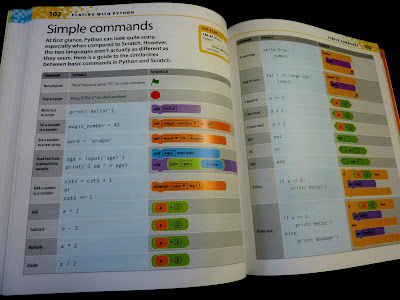

This third section is a brief introduction to what's inside a computer.

The last section is about programming in the real world.

I bought this book from Costco for $11.95 last year, but a couple of weeks ago, when I went to Costco, I saw it there, again. So, if you have a Costco in your neighborhood (and who doesn't), you might want to pick one up. It's a great deal at the sticker price of $19.95 (especially when you think about how much you have to pay for a week of programming classes).
Enjoy!

I've heard a lot about coding, and when I saw it at Costco while back, I thought I'd pick it up. I don't know much about coding, and I thought this might be a good book for all of us (my daughter and me) to get started.
One thing I REALLY like about this book is that it seems so friendly. Technical books can be quite intimidating, yet this one is quite friendly with a lot of graphics and explanations. As I said, I don't know much about coding, so this was a good fit for me. But if you know a little more, I'm not sure how you'd feel about this book. You might think it's too easy.
This book is broken into roughly four sections.
The first section is about Scratch (an MIT developed coding language).

My daughter and I worked on installing it and working on a project together last year when she was in 2nd grade. Sure, we had our share of glitches (typos for small fingers), but it was fairly painless to follow the book & program something to see it work.
The second section is about Python. Python is a text-based programming language (the type I'm familiar with). Dare I date myself and tell you that my first computer language was...Fortran?

OK. I haven't coded in Python, yet, but one thing I love about this book is that it gives you equivalent commands in both Python (left hand light blue column) and Scratch (right hand more colorful column). So, if you've coded with Scratch already, it would be easier for you to understand what you're doing in Python (theoretically speaking).
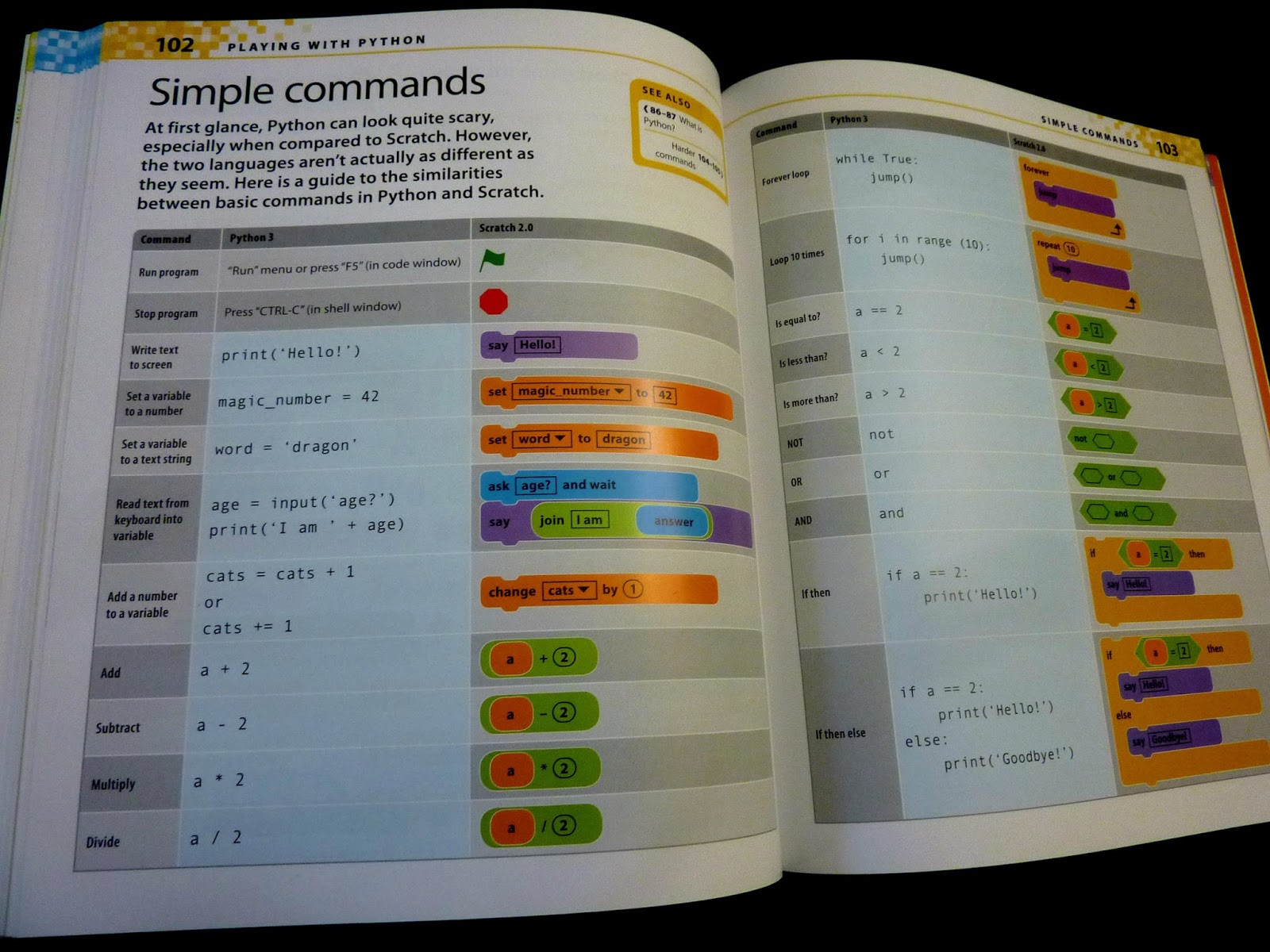

This third section is a brief introduction to what's inside a computer.

The last section is about programming in the real world.

I bought this book from Costco for $11.95 last year, but a couple of weeks ago, when I went to Costco, I saw it there, again. So, if you have a Costco in your neighborhood (and who doesn't), you might want to pick one up. It's a great deal at the sticker price of $19.95 (especially when you think about how much you have to pay for a week of programming classes).
Enjoy!
Tuesday, February 10, 2015
Ender's Game by Orson Scott Card
This book surprised me in a couple of ways.
I'm pretty good at guessing the ending of the book. Maybe it's because I'm a writer, but I can consistently guess the ending. However, I had no idea how this book would end, and even a few tendrils of ideas I had, nothing worked out the way I thought it might.
The book rating on the back cover said Ages 10 and Up, but I'm not sure I agree with that. There is a certain viciousness in this book that startled and shocked me. I didn't expect it from such a young character. Although a lot of books have Ages so and up, usually the kids who are at least 2 or 3 years younger start to read up to the age rating. At that point, I feel that this book is not appropriate for kids who are younger than 10. AND I wouldn't let my daughter read it until she's about 11 or 12.
HOWEVER, I enjoyed this book, and I'd like to recommend it to anyone who likes a good action/adventure. That is anyone older than 10, but probably 12.
Spoiler Alert~
Ender lives in a dangerous world where the Aliens nicknamed "buggers" have invaded the earth twice already. Every Earthlings' life is predicated by the impending third bugger invasion.
In this world of limited resources and impending doom, Ender is also a dreaded "third." In a world where there is two-child-per-family policy, being a "third" itself is a reason for derision. He is picked on by his classmates, and he is harassed by his older brother who resents him for being more talented and capable of meeting the demands of military training.
But he is a cunning, ruthless, military genius, and he is sent to Battle School to hone his strategic and tactical skills pitted against other brilliant students of Battle School. There, he excels once again by coming up with mock battle plans that surprise and impress his superiors. His team never loses a battle, no matter how it is outnumbered and disadvantaged. His successes in Battle School convince his teachers to Command School, skipping several years of additional training.
In Command School, he is isolated from the rest and interacts mostly with his mentor, the previous conflict's war hero, Mazer. He spends most of his time fighting buggers in simulation, and he is depressed by the endless simulations and isolated existence.
For his "final" test, Ender's fleet is outnumbered by the buggers by a lot, and he sacrifices most of his fighters to launch a weapon that destroyed the entire bugger planet. Ender thinks this act of rebellion will get him kicked out of Command School. Instead, he learns that the "simulations" weren't simulations. In fact, they represented the actual international fleet, buggers' fleet, and buggers' home world. Ender has won the bugger war for the humanity.
Winning the bugger war has opened a bigger can of worms on Earth where various powers fight amongst themselves for the control. Due to his capabilities, he cannot return to Earth. He decides to become a colonist on one of the buggers' worlds. There he learns that bugger invasions were based on misunderstandings and mistakes, and he finds a dormant egg of the bugger queen. In the end, he and his sister board a starship to search for a safe world to establish another bugger colony.
I skipped a big chunk of plot that involves his brother and sister, but I wanted to concentrate on Ender. I really enjoyed the strategy and tactics Ender used to win his mock battles in Battle School and Command School; however, I had problems with what finally led to Ender's entry into Battle School and Command School. His brutal beating of a classmate bully lands him not in jail, but in coveted Battle School. And when he is ambushed, he responds with overwhelming force, and it gets him promoted to Command School. In both cases, his opponents are dead. It's this rewarding of his ruthlessness that I find objectionable.
However, I did enjoy the book, and I think I would recommend the book to those who enjoy action or sci-fi.
PS - I also read Ender's Shadow, and the same brutality, cunning, and ruthlessness are threaded in this book for a main character who is even younger (starts out at 4), and I just couldn't recommend the book. And I didn't enjoy it. It was too much, but I finished, hoping that things would change. It didn't.
I'm pretty good at guessing the ending of the book. Maybe it's because I'm a writer, but I can consistently guess the ending. However, I had no idea how this book would end, and even a few tendrils of ideas I had, nothing worked out the way I thought it might.
The book rating on the back cover said Ages 10 and Up, but I'm not sure I agree with that. There is a certain viciousness in this book that startled and shocked me. I didn't expect it from such a young character. Although a lot of books have Ages so and up, usually the kids who are at least 2 or 3 years younger start to read up to the age rating. At that point, I feel that this book is not appropriate for kids who are younger than 10. AND I wouldn't let my daughter read it until she's about 11 or 12.
HOWEVER, I enjoyed this book, and I'd like to recommend it to anyone who likes a good action/adventure. That is anyone older than 10, but probably 12.
Spoiler Alert~
Ender lives in a dangerous world where the Aliens nicknamed "buggers" have invaded the earth twice already. Every Earthlings' life is predicated by the impending third bugger invasion.
In this world of limited resources and impending doom, Ender is also a dreaded "third." In a world where there is two-child-per-family policy, being a "third" itself is a reason for derision. He is picked on by his classmates, and he is harassed by his older brother who resents him for being more talented and capable of meeting the demands of military training.
But he is a cunning, ruthless, military genius, and he is sent to Battle School to hone his strategic and tactical skills pitted against other brilliant students of Battle School. There, he excels once again by coming up with mock battle plans that surprise and impress his superiors. His team never loses a battle, no matter how it is outnumbered and disadvantaged. His successes in Battle School convince his teachers to Command School, skipping several years of additional training.
In Command School, he is isolated from the rest and interacts mostly with his mentor, the previous conflict's war hero, Mazer. He spends most of his time fighting buggers in simulation, and he is depressed by the endless simulations and isolated existence.
For his "final" test, Ender's fleet is outnumbered by the buggers by a lot, and he sacrifices most of his fighters to launch a weapon that destroyed the entire bugger planet. Ender thinks this act of rebellion will get him kicked out of Command School. Instead, he learns that the "simulations" weren't simulations. In fact, they represented the actual international fleet, buggers' fleet, and buggers' home world. Ender has won the bugger war for the humanity.
Winning the bugger war has opened a bigger can of worms on Earth where various powers fight amongst themselves for the control. Due to his capabilities, he cannot return to Earth. He decides to become a colonist on one of the buggers' worlds. There he learns that bugger invasions were based on misunderstandings and mistakes, and he finds a dormant egg of the bugger queen. In the end, he and his sister board a starship to search for a safe world to establish another bugger colony.
I skipped a big chunk of plot that involves his brother and sister, but I wanted to concentrate on Ender. I really enjoyed the strategy and tactics Ender used to win his mock battles in Battle School and Command School; however, I had problems with what finally led to Ender's entry into Battle School and Command School. His brutal beating of a classmate bully lands him not in jail, but in coveted Battle School. And when he is ambushed, he responds with overwhelming force, and it gets him promoted to Command School. In both cases, his opponents are dead. It's this rewarding of his ruthlessness that I find objectionable.
However, I did enjoy the book, and I think I would recommend the book to those who enjoy action or sci-fi.
PS - I also read Ender's Shadow, and the same brutality, cunning, and ruthlessness are threaded in this book for a main character who is even younger (starts out at 4), and I just couldn't recommend the book. And I didn't enjoy it. It was too much, but I finished, hoping that things would change. It didn't.
Friday, January 9, 2015
Micro by Michael Crichton & Richard Preston
"In 2008, the famous naturalist David Attenborough expressed concern that modern schoolchildren could not identify common plants and insects found in nature, although previous generations identified them without hesitation.
It was ironic that this should be happening at a time when there was in the West an ever greater concern for the environment, and ever more ambitious steps proposed to protect it.
Indoctrinating children in proper environmental thought was a hallmark of the green movement, and so children were being instructed to protect something about which they knew nothing at all."
I agree with Michael Crichton - we should know or strive to know about things we try to protect.
Though we go camping, and my children play outside quite often, we don't know the names of the plants and trees growing in the nearby park. I guess this is something I should work to change.
When I read a book, especially fiction, I want it to do one thing for me. Just one. Take me to a place or time where I would learn something new. Michael Crichton's books have consistently done that for me, and it saddens me to know that he passed away few years back.
This book follows similar Michael Crichton patterns - where main characters' survival is at stake against a form of advanced technology, surprising ways the complex of nature responds to external stimuli, and the fact that technological advances can be seen as a double-edged sword without a hilt to wield it.
~Spoiler Alert~
The president of Nanigen is interested in hiring promising graduate students and invites seven promising Ph.D. students from the east coast to check out his facility in Hawaii. There one of the grad students learns that the president murdered his brother who had been working at Nanigen as a director. To cover up his crime more completely, he shrinks the grad students and abandons them in the middle of the rain forest in Hawaii. Now, the students must fight the elements, natural predators, and the advanced micro technology that is available in the Nanigen president's arsenal to survive.
The thing I enjoyed most about the book was the minute details of nature seen from the micro inhabitants, rather than larger human view. The surface tension on a raindrop or what the forest floor would feel like to microscopic creatures were awesome. You realize that laws of nature act differently at micro levels and that in itself presents a problem to micro-sized humans.
I have always enjoyed reading Michael Crichton's books, and I'm going to miss him in my reading life very much.
I'd recommend this book to anyone who likes a good read.
It was ironic that this should be happening at a time when there was in the West an ever greater concern for the environment, and ever more ambitious steps proposed to protect it.
Indoctrinating children in proper environmental thought was a hallmark of the green movement, and so children were being instructed to protect something about which they knew nothing at all."
I agree with Michael Crichton - we should know or strive to know about things we try to protect.
Though we go camping, and my children play outside quite often, we don't know the names of the plants and trees growing in the nearby park. I guess this is something I should work to change.
When I read a book, especially fiction, I want it to do one thing for me. Just one. Take me to a place or time where I would learn something new. Michael Crichton's books have consistently done that for me, and it saddens me to know that he passed away few years back.
This book follows similar Michael Crichton patterns - where main characters' survival is at stake against a form of advanced technology, surprising ways the complex of nature responds to external stimuli, and the fact that technological advances can be seen as a double-edged sword without a hilt to wield it.
~Spoiler Alert~
The president of Nanigen is interested in hiring promising graduate students and invites seven promising Ph.D. students from the east coast to check out his facility in Hawaii. There one of the grad students learns that the president murdered his brother who had been working at Nanigen as a director. To cover up his crime more completely, he shrinks the grad students and abandons them in the middle of the rain forest in Hawaii. Now, the students must fight the elements, natural predators, and the advanced micro technology that is available in the Nanigen president's arsenal to survive.
The thing I enjoyed most about the book was the minute details of nature seen from the micro inhabitants, rather than larger human view. The surface tension on a raindrop or what the forest floor would feel like to microscopic creatures were awesome. You realize that laws of nature act differently at micro levels and that in itself presents a problem to micro-sized humans.
I have always enjoyed reading Michael Crichton's books, and I'm going to miss him in my reading life very much.
I'd recommend this book to anyone who likes a good read.
The Autobiography of Mrs. Tom Thumb by Melanie Benjamin
I'm at the Dollar Tree a lot because that's where I get most of my science project materials. When I have to buy project supplies 200+ students for very little money, I go where I can get good deals on straws, toothpicks, plastic cups, etc. So, while I'm there, I look around and quite often, find a gem of a book. This is one of them.
What a surprising read! I'm not sure if I would have picked up this book on my own, but I'm glad I did.
~Spoiler Alert~
Known as Mrs. Tom Thumb, Mercy Lavinia "Vinnie" Warren Bump was born a normal infant. But she suffered a pituitary disorder, which led to her proportionate dwarfism. Her family wanted to hide her from the eyes of the world, but she longed for another, more public life which afforded wider interaction with others.
At two feet, eight inches tall, she is small, to say the least. This book highlights Vinnie's life as a part of the circus act of P.T. Barnum, but what I find even more remarkable is that she held her own against village children as a school teacher before she embarked on her circus career. The fact that she can keep a classroom of children, some of whom are much, much taller than her, is a testament to her character and her will.
So, it comes as no surprise to me that she jumps at the chance to join the circus that supposed "family cousin" is running. Sure, she still has her school and teaching, but she chafes against the strict confines of the social norms. If she stays, she's relegated to the life of spinsterhood, a woman to be pitied in the neighborhood and included when occasion called for it.
Vinnie finally convinces her family to let her go with Colonel Wood to his "floating palace of entertainment," she's ready for an adventure, but what she finds is much more than what she expects. Even after she escapes that situation where she had been in physical danger of being raped or abused, her heart yearns for an adventure. So, SHE writes P.T. Barnum, offering her services in his circus.
There she meets P.T. Barnum and her future husband, Charles Sherwood, aka General Tom Thumb. As her circus act becomes more and more popular, especially after she marries General Tom Thumb (which preempts the coverage of the Civil War), she's in the company of presidents and royalty. However, life is anything but happy.
Their fame wanes after the dizzying heights and they are relegated to getting back on the trains (not P.T. Barnum's private trains) and going from town to town to perform. And her even smaller sister, Mini, joins her at the circus after being her bridesmaid for the wedding. But Mini is not made of the same stuff as Vinnie, and she doesn't enjoy the public life. All she wants is to return to her normal life, but her desire to stay close to Vinnie keeps Mini at the circus.
Eventually, Mini marries another circus performer, another small-sized man, and while giving birth to a normal sized baby, both the baby and Mini die. This tragic event marks the beginning of the end of a lot of relationships she has people around her - her husband and P.T. Barnum.
This is an epic novel about a woman who refused to be defined by her size and allow others, be it family or strangers, to dictate how she should live her life.
Vinnie's sheer determination to live the life she wants is awe-inspiring, to say the least. How she thought to control a classroom of kids (kids her days may have had more respect for her position as a teacher, but it couldn't have been easy), then go on to the unknown world of performing on "floating palaces" on the Mississippi. She consistently makes bold choices, even though at times, she feels that she has no other choice.
I hope I can live my life the way Vinnie did, with a sense of adventure and determination to follow my dreams, no matter what others say.
Two thumbs up! Way, way up!
What a surprising read! I'm not sure if I would have picked up this book on my own, but I'm glad I did.
~Spoiler Alert~
Known as Mrs. Tom Thumb, Mercy Lavinia "Vinnie" Warren Bump was born a normal infant. But she suffered a pituitary disorder, which led to her proportionate dwarfism. Her family wanted to hide her from the eyes of the world, but she longed for another, more public life which afforded wider interaction with others.
At two feet, eight inches tall, she is small, to say the least. This book highlights Vinnie's life as a part of the circus act of P.T. Barnum, but what I find even more remarkable is that she held her own against village children as a school teacher before she embarked on her circus career. The fact that she can keep a classroom of children, some of whom are much, much taller than her, is a testament to her character and her will.
So, it comes as no surprise to me that she jumps at the chance to join the circus that supposed "family cousin" is running. Sure, she still has her school and teaching, but she chafes against the strict confines of the social norms. If she stays, she's relegated to the life of spinsterhood, a woman to be pitied in the neighborhood and included when occasion called for it.
Vinnie finally convinces her family to let her go with Colonel Wood to his "floating palace of entertainment," she's ready for an adventure, but what she finds is much more than what she expects. Even after she escapes that situation where she had been in physical danger of being raped or abused, her heart yearns for an adventure. So, SHE writes P.T. Barnum, offering her services in his circus.
There she meets P.T. Barnum and her future husband, Charles Sherwood, aka General Tom Thumb. As her circus act becomes more and more popular, especially after she marries General Tom Thumb (which preempts the coverage of the Civil War), she's in the company of presidents and royalty. However, life is anything but happy.
Their fame wanes after the dizzying heights and they are relegated to getting back on the trains (not P.T. Barnum's private trains) and going from town to town to perform. And her even smaller sister, Mini, joins her at the circus after being her bridesmaid for the wedding. But Mini is not made of the same stuff as Vinnie, and she doesn't enjoy the public life. All she wants is to return to her normal life, but her desire to stay close to Vinnie keeps Mini at the circus.
Eventually, Mini marries another circus performer, another small-sized man, and while giving birth to a normal sized baby, both the baby and Mini die. This tragic event marks the beginning of the end of a lot of relationships she has people around her - her husband and P.T. Barnum.
This is an epic novel about a woman who refused to be defined by her size and allow others, be it family or strangers, to dictate how she should live her life.
Vinnie's sheer determination to live the life she wants is awe-inspiring, to say the least. How she thought to control a classroom of kids (kids her days may have had more respect for her position as a teacher, but it couldn't have been easy), then go on to the unknown world of performing on "floating palaces" on the Mississippi. She consistently makes bold choices, even though at times, she feels that she has no other choice.
I hope I can live my life the way Vinnie did, with a sense of adventure and determination to follow my dreams, no matter what others say.
Two thumbs up! Way, way up!
Monday, December 29, 2014
Finding Jack by Gareth Crocker
I grew up in Korea, and when I was a child, I didn't see any pet dogs in my neighborhood. However, there was a scary guard dog in our neighborhood, and it became a daily trial to walk in front of the doors of that house. I would tip-toe to the house, then run across as fast as I could because I was so scared of the dog's loud and menacing bark.
This was the extent of my exposure to dogs until I met my husband to be. Now, we are a family of dog lovers. My favorite quote about dogs - Not everyone knows how to love a dog, but every dog knows how to love a person.
But this book shows the width and the depth of love and devotion one man feels for the dog that not only saves his life and the lives of others on patrol with him, but gives him a reason to live. The extraordinary lengths Fletcher will go to save Jack's life is crazy, stupid, and incredibly inspiring.
~Spoiler Alert~
Fletcher Carson enlists for the Vietnam War for all the wrong reasons. He had recently lost his wife and daughter, and he didn't want to go on living. At 29, he enlists, and a friend asks him why.
"Our soldiers are being massacred in Vietnam. Most of them are still kids. They've got their whole lives ahead of them. It makes sense that people like me enlist."
He enlists, but it doesn't mean he has a death wish. He merely goes through motions of doing what he needs to do, but he's not fully engaged in fighting or trying to stay alive until he meets Jack, a yellow Lab. A yellow Lab emerges from the trees already injured, but the soldiers are weary of such encounters. They already heard enough stories of rigged injured animals being blown up as the American soldiers tried to help them. So, immediately, their leader orders Fletcher to "take him out." When Fletcher refuses, another soldier is ordered, and he shoots the dog. The dog is gravely injured, but Fletcher carries the dog back to the base.
At the base, Jack recovers from his injuries and goes out on patrols with Fletcher's group. Many times, Jack saves the lives of Fletcher's group, and eventually the war ends with both Fletcher and Jack surviving the ordeal, even though several from his group had died in battle. By the war's end, Fletcher is convinced that Jack was sent by his dead daughter to let him know that she and her mother, Fletcher's wife are doing OK. BUT the end was anything but what Fletcher had imagined. The dogs that kept so many of the soldiers alive were considered "surplus military equipment," and the plan was to abandon them in Vietnam.
This is not an acceptable solution to Fletcher, and he tries to find a way to take Jack back home with him. But there is no other way but one. Fletcher jumps from a helicopter as it lifts off, and stay on with Jack. Now, he and Jack must find their way out of Vietnam by land (Vietnam to Laos to Thailand). It is a harrowing journey strewn with extreme dangers, both natural and man-made, but together, they overcome them all. In the end, they make it to Thailand, and finally, they are able to come to America together. He even bring out others who have helped him survive his nightmarish ordeal.
I love to learn something new from a book, and though I don't feel that I've learned anything new from this book, it was an enjoyable read. The only complaint I have about this books is that over and over, right people with right equipment came just in nick of time to rescue Fletcher and Jack, especially at the end on their journey out of Vietnam.
I'd recommend this book to any dog lover, but anyone who is interested in an enjoyable read.
This was the extent of my exposure to dogs until I met my husband to be. Now, we are a family of dog lovers. My favorite quote about dogs - Not everyone knows how to love a dog, but every dog knows how to love a person.
But this book shows the width and the depth of love and devotion one man feels for the dog that not only saves his life and the lives of others on patrol with him, but gives him a reason to live. The extraordinary lengths Fletcher will go to save Jack's life is crazy, stupid, and incredibly inspiring.
~Spoiler Alert~
Fletcher Carson enlists for the Vietnam War for all the wrong reasons. He had recently lost his wife and daughter, and he didn't want to go on living. At 29, he enlists, and a friend asks him why.
"Our soldiers are being massacred in Vietnam. Most of them are still kids. They've got their whole lives ahead of them. It makes sense that people like me enlist."
He enlists, but it doesn't mean he has a death wish. He merely goes through motions of doing what he needs to do, but he's not fully engaged in fighting or trying to stay alive until he meets Jack, a yellow Lab. A yellow Lab emerges from the trees already injured, but the soldiers are weary of such encounters. They already heard enough stories of rigged injured animals being blown up as the American soldiers tried to help them. So, immediately, their leader orders Fletcher to "take him out." When Fletcher refuses, another soldier is ordered, and he shoots the dog. The dog is gravely injured, but Fletcher carries the dog back to the base.
At the base, Jack recovers from his injuries and goes out on patrols with Fletcher's group. Many times, Jack saves the lives of Fletcher's group, and eventually the war ends with both Fletcher and Jack surviving the ordeal, even though several from his group had died in battle. By the war's end, Fletcher is convinced that Jack was sent by his dead daughter to let him know that she and her mother, Fletcher's wife are doing OK. BUT the end was anything but what Fletcher had imagined. The dogs that kept so many of the soldiers alive were considered "surplus military equipment," and the plan was to abandon them in Vietnam.
This is not an acceptable solution to Fletcher, and he tries to find a way to take Jack back home with him. But there is no other way but one. Fletcher jumps from a helicopter as it lifts off, and stay on with Jack. Now, he and Jack must find their way out of Vietnam by land (Vietnam to Laos to Thailand). It is a harrowing journey strewn with extreme dangers, both natural and man-made, but together, they overcome them all. In the end, they make it to Thailand, and finally, they are able to come to America together. He even bring out others who have helped him survive his nightmarish ordeal.
I love to learn something new from a book, and though I don't feel that I've learned anything new from this book, it was an enjoyable read. The only complaint I have about this books is that over and over, right people with right equipment came just in nick of time to rescue Fletcher and Jack, especially at the end on their journey out of Vietnam.
I'd recommend this book to any dog lover, but anyone who is interested in an enjoyable read.
Monday, December 1, 2014
The Name Jar by Yangsook Choi
One of the teachers I work with at my daughter's elementary school introduced me to this book, and I absolutely loved it. Let me tell you why.

I immigrated to the US when I was ten-years-old from South Korea. Though, at the time, I found consolation in my false impressions that my father spoke English, but I soon found out how little English he actually spoke at the time. Due to lack of English language skills, my brothers and I were teased quite often, but more than anything, our weird names painted big, fat target on our backs.
My Korean name is Ryoung Ah. This is enunciated with the silent R, usually, but the correct enunciation rolls the R in front of the y. But how could the kids in my 4th grade have known? They had to make do with a jumble of letters that you just don't see in American names very often. So, my name got butchered from Rye-young-gah to R-youn-gah, to any number of unwieldy sounds. But I didn't have the courage to correct any of them. One of my brother's name is Dong Hwan, but it got changed to Ding Dong. Dong Dong, etc. The other brother's name is Kyung Tai, but it got changed to Kee-young-tie, etc.
Needless to say, changing Korean names to American names sounded like a good idea, and we did. But even in this, my path to finding an American name of my own wasn't smooth. I liked Christine. Christine Kim had a nice ring to it. So, the next day, I went to school and told another Korean girl that beginning next Monday, I was going to everyone to call me Christine. Well, that "friend" had told everyone to call her Christine after the first recess, and I was left out in the cold. I had to start my search for an American name all over again. Finally, by the end of next week, I settled on Jennifer. I don't even remember if I particularly liked the name, but I chose it because I knew no one else named Jennifer.
With all these stories behind how I ended up with my name, I enjoyed this wonderful book and loved the choice she made. I think it was the right choice for her, but I also realize that I made the right choice for me.
I am Jennifer Ryoung Ah Kim.
P.S. I thought I should add this funny story. When we first got here, my brothers and I were desperate to make friends, and wondered why it was so hard to make friends.... Well, before we started school, my Korean-American uncle taught us a phrase that supposed to keep us out of trouble.
The phrase was... I can't speak English. Please, leave me alone.
What?!? I know.
Even now, I have a hard time believing that my uncle actually taught us the phrase thinking it would solve all kinds of problems. And here we were, wondering why we couldn't make any friends.
I immigrated to the US when I was ten-years-old from South Korea. Though, at the time, I found consolation in my false impressions that my father spoke English, but I soon found out how little English he actually spoke at the time. Due to lack of English language skills, my brothers and I were teased quite often, but more than anything, our weird names painted big, fat target on our backs.
My Korean name is Ryoung Ah. This is enunciated with the silent R, usually, but the correct enunciation rolls the R in front of the y. But how could the kids in my 4th grade have known? They had to make do with a jumble of letters that you just don't see in American names very often. So, my name got butchered from Rye-young-gah to R-youn-gah, to any number of unwieldy sounds. But I didn't have the courage to correct any of them. One of my brother's name is Dong Hwan, but it got changed to Ding Dong. Dong Dong, etc. The other brother's name is Kyung Tai, but it got changed to Kee-young-tie, etc.
Needless to say, changing Korean names to American names sounded like a good idea, and we did. But even in this, my path to finding an American name of my own wasn't smooth. I liked Christine. Christine Kim had a nice ring to it. So, the next day, I went to school and told another Korean girl that beginning next Monday, I was going to everyone to call me Christine. Well, that "friend" had told everyone to call her Christine after the first recess, and I was left out in the cold. I had to start my search for an American name all over again. Finally, by the end of next week, I settled on Jennifer. I don't even remember if I particularly liked the name, but I chose it because I knew no one else named Jennifer.
With all these stories behind how I ended up with my name, I enjoyed this wonderful book and loved the choice she made. I think it was the right choice for her, but I also realize that I made the right choice for me.
I am Jennifer Ryoung Ah Kim.
P.S. I thought I should add this funny story. When we first got here, my brothers and I were desperate to make friends, and wondered why it was so hard to make friends.... Well, before we started school, my Korean-American uncle taught us a phrase that supposed to keep us out of trouble.
The phrase was... I can't speak English. Please, leave me alone.
What?!? I know.
Even now, I have a hard time believing that my uncle actually taught us the phrase thinking it would solve all kinds of problems. And here we were, wondering why we couldn't make any friends.
A free book giveaway on Amazon
Hello everyone. I guess it makes sense that I should love my own book, but this one is particularly personal in regards that it's based on a dream.
I'm running a promotion on Amazon. You can download my latest book, Last Chance Lane by Jennifer R. Kim, for free on 12/3.
I'll tell you about how things are going in my next blog.
Enjoy!
I'm running a promotion on Amazon. You can download my latest book, Last Chance Lane by Jennifer R. Kim, for free on 12/3.
I'll tell you about how things are going in my next blog.
Enjoy!
Saturday, November 15, 2014
The Lady and the Poet by Maeve Haran
John Donne. Anne Donne. Undone.
I remember reading these lines in high school English class and wondered what would induce John Donne to pen such words. These simple words intrigued me far more than any of his poems (maybe I just don't have a poetic soul, but such is the case), but I didn't do anything to find out what he wrote such words. Then a couple of weeks ago, at a library book sale, I picked up this book because I still remembered these words. And now, after having read this book, I want to read his poems.
Spoiler Alert~
Anne Donne (formerly Anne More) came from wealth and privilege. Her unusual grandfather educated her far beyond what would have been acceptable as a young woman, and she had spirit and fire to match her keen intelligence. It was decided that Anne should come to London and stay with her aunt. She was destined to become on of Queen Elizabeth's ladies-in-waiting, resulting in an advantageous marriage. At her aunt's house, she meets John Donne; he was her uncle's secretary.
When they first met, she's thirteen years old, but John Donne mistook her for a servant and propositioned her at their first meeting. At a later meeting, she corrected his error and put him in his place. This was the start of their attraction to one another; however, there were several, almost insurmountable obstacles.
Compared to Anne's esteemed background, John was merely a servant in her uncle's household. Anne's highly status conscious father would never want someone like John, who could offer nothing to him, as his son-in-law. When they met, he was a man of 25 who wrote bawdy poems and had a string of women (both high-born and low-born) at his beck-and-call. She was an innocent girl of 13 who was at the cusp of her womanhood. There was a chance he might be thrown into prison. In the time of Bloody Mary and Elizabeth I reign, he was a Catholic, and she was raised Protestant. This alone could have led to great strife. Most importantly, they knew they would most likely be completely ostracized by all those who knew them and might face financial ruin if they act on their love and affection for one another. Even as they faced all these consequences, they married one another in secret when she was 17 years old.
When John Donne revealed their secret marriage to Anne's father a year later, he's thrown in prison, and Anne's father proceeded to dispute the validity of the marriage. However, their marriage was upheld by the courts. Anne's father refused to pay her dowry, and John lost his position. Now, they were forced to live off the charity of Anne's cousin in the country. Though constantly under financial pressures (Anne's father was rather vindictive and slow in paying out her dowry), John and Anne lived happily.
Anne died at the age of 33, after delivering a stillborn child, her 12th child. John never recovered for Anne's death and lived the rest of his life (another 14 years) alone.
This wonderful book brought forth some very interesting points about John and Anne Donne.
John Donne was a worldly man compared to Anne, with bawdy verses, mistresses and what seems like a great appreciation for the good life. So, what induced him to give up all that for Anne? Anne must have been one remarkable young woman, to intrigue, to attract, and to hold his attention for the rest of her life.
Anne's cousin, who supported her and her family for a long time, must be a very generous man who had an understanding wife (is this too modern way of thinking?). It must cost a lot of money to provide housing as well as some level of necessities for the family (especially when Anne and John had many children). Remember, she died after her 12th baby was stillborn? I'm more used to very demanding and judgmental English upper-crust families (from literature) to cut themselves completely off from a wayward family member. Good thing John Donne and Anne Donne weren't completely Undone.
John must have loved Anne dearly. He became a priest after Anne's death. It must have been hellish for him to wake up and know that he must face another day without her (especially in the beginning). Maybe he did find consolation in God.
Very little is known about Anne Donne. I wish there were more of her from historical sources. She would have been a very interesting person, I bet.
Though I had never been interested in John Donne before, I am eager to get my hands on a volume of poetry.
I remember reading these lines in high school English class and wondered what would induce John Donne to pen such words. These simple words intrigued me far more than any of his poems (maybe I just don't have a poetic soul, but such is the case), but I didn't do anything to find out what he wrote such words. Then a couple of weeks ago, at a library book sale, I picked up this book because I still remembered these words. And now, after having read this book, I want to read his poems.
Spoiler Alert~
Anne Donne (formerly Anne More) came from wealth and privilege. Her unusual grandfather educated her far beyond what would have been acceptable as a young woman, and she had spirit and fire to match her keen intelligence. It was decided that Anne should come to London and stay with her aunt. She was destined to become on of Queen Elizabeth's ladies-in-waiting, resulting in an advantageous marriage. At her aunt's house, she meets John Donne; he was her uncle's secretary.
When they first met, she's thirteen years old, but John Donne mistook her for a servant and propositioned her at their first meeting. At a later meeting, she corrected his error and put him in his place. This was the start of their attraction to one another; however, there were several, almost insurmountable obstacles.
Compared to Anne's esteemed background, John was merely a servant in her uncle's household. Anne's highly status conscious father would never want someone like John, who could offer nothing to him, as his son-in-law. When they met, he was a man of 25 who wrote bawdy poems and had a string of women (both high-born and low-born) at his beck-and-call. She was an innocent girl of 13 who was at the cusp of her womanhood. There was a chance he might be thrown into prison. In the time of Bloody Mary and Elizabeth I reign, he was a Catholic, and she was raised Protestant. This alone could have led to great strife. Most importantly, they knew they would most likely be completely ostracized by all those who knew them and might face financial ruin if they act on their love and affection for one another. Even as they faced all these consequences, they married one another in secret when she was 17 years old.
When John Donne revealed their secret marriage to Anne's father a year later, he's thrown in prison, and Anne's father proceeded to dispute the validity of the marriage. However, their marriage was upheld by the courts. Anne's father refused to pay her dowry, and John lost his position. Now, they were forced to live off the charity of Anne's cousin in the country. Though constantly under financial pressures (Anne's father was rather vindictive and slow in paying out her dowry), John and Anne lived happily.
Anne died at the age of 33, after delivering a stillborn child, her 12th child. John never recovered for Anne's death and lived the rest of his life (another 14 years) alone.
This wonderful book brought forth some very interesting points about John and Anne Donne.
John Donne was a worldly man compared to Anne, with bawdy verses, mistresses and what seems like a great appreciation for the good life. So, what induced him to give up all that for Anne? Anne must have been one remarkable young woman, to intrigue, to attract, and to hold his attention for the rest of her life.
Anne's cousin, who supported her and her family for a long time, must be a very generous man who had an understanding wife (is this too modern way of thinking?). It must cost a lot of money to provide housing as well as some level of necessities for the family (especially when Anne and John had many children). Remember, she died after her 12th baby was stillborn? I'm more used to very demanding and judgmental English upper-crust families (from literature) to cut themselves completely off from a wayward family member. Good thing John Donne and Anne Donne weren't completely Undone.
John must have loved Anne dearly. He became a priest after Anne's death. It must have been hellish for him to wake up and know that he must face another day without her (especially in the beginning). Maybe he did find consolation in God.
Very little is known about Anne Donne. I wish there were more of her from historical sources. She would have been a very interesting person, I bet.
Though I had never been interested in John Donne before, I am eager to get my hands on a volume of poetry.
1356 by Bernard Cornwell
I have always loved action adventures. In fact, action adventure books (The Three Musketeers, The Scarlet Pimpernel, The Man in the Iron Mask, The Count of Monte Cristo, The Black Night, Ivanhoe, Quo Vadis?, Arsene Lupin books, Sherlock Holmes books, etc.) have kept me sane in the first couple of years of immigration when I felt so alone and lost. These books were my friends, and they helped me keep my spirits up. They taught me never to give up and keep on fighting for what I believed in.
These are some of the most-treasured books I own (especially since they were from a 100 Masterpiece in the World young adult collection in Korean that my parents brought with us when we immigrated to the United States). Some of my favorite modern action adventure writers are Clive Cussler, Micheal Crichton, Daniel Silva, Sharon Kay Penman, etc. And now, I have another to add to the list - Bernard Cornwell.
What I love about these books is that for a short span of time, they take me on a fantastic adventure. I'm so busy keeping my wits about me that I forget to worry about such mundane things as learning English and finishing my Language Arts homework.
Now, on to the review - I love the books I love in this genre for the same reason. They take me to a very exciting place and give me a great roller coaster ride. However, I have yet to write a review about any of the books I love reading on this blog because at the end of the day, they don't linger in my head, making me think about it for a long time, until this book.
I loved the details of medieval life in this book. I can feel the damp chill in the crypt. I can smell the acrid smoke wafting up to the sky. I can feel the blood pounding in my veins with every sword thrust and axe swing. I can share the profound grief in losing love ones so needlessly. All this is wonderful enough, but in the heart of this story is a man driven by his own moral code in the time when a sense of righteousness and moral authority was hijacked by the nobility and Catholic Church and used for their gain rather than for God's justice and mercy.
~Spoiler Alert~
In the time of relic collecting, when a notable relic not only made or broke the church that housed it, but the whole region, Sword of Saint Peter was one of the most sought after relic. Saint Peter purportedly used the sword to slice one of the soldier's ear when they came to take Jesus away to Pontius Pilate. This sword was believed to have mystical powers, and it supposedly granted certain victory to whoever possessed it. With another war between the English and the French looming ahead, the race was on from all sides to find it at all cost.
As the relic hunters drew close, those who were responsible for keeping it safe were forced to move it, and this movement created more upheaval in times of chaos.In these troubling times, Sir Thomas Hookton is busy sacking a castle for a French Count whose wife ran away with the lord of the castle. Sir Thomas Hookton is a very successful mercenary known as Le Batard, and he leads a troop of archers and men-at-arms to serve whoever pays him the most money. Though he meets his end of the bargain, the Count in question, even after having retrieved his errant wife and exacted gruesome revenge on the lord of the castle, short-changes Le Batard. Before Le Batard could collect his just payment from the Count, he is called back by his British liege lord and sent on an important mission to find the Sword of Saint Peter.
Here are some excerpts -
"Bernard Cornwell does the best battle scenes of any writer I've read, past or present."
- George R. R. Martin (author of Game of Thrones)
"His characters are vividly drawn, betrayals lurk around every corner, the humor is as sharp as swords, and the action is nonstop."
- Sharon Kay Penman (one of my personal favorites)
"Cornwell's cinematically detailed battle pieces are literal tours de force."
- Washington Post
Now, on to why I really loved this book.... As I was reading it, everything seemed so unfair. Those who had rank and money could do anything they wanted to do. And the Catholic Church, with its supposed moral righteousness behind it, did everything it wanted to do. A priest's word was all the society needed to find someone guilty of consorting with the devil or some other crime (by the way, how do you fight such a claim? Where can anyone begin?). Then this person would be executed, in very cruel way for that crime. There was very little anyone could do to save a person who had been label thus (especially in places far away from large towns). When I thought about what it would be like to watch my loved one jailed, tortured, then executed for no crime greater than a crime of expediency for the powerful, the impotence of the situation horrified me.
A couple of night ago, I was laying down with my little daughter who called for me in the early morning. Just as I was holding her, a stream of sunshine fingered into her room and illuminated the side of her face where she has a small mole close to her hairline. That mole sent a chill down my spine as I was transported back to the world of 1356. My daughter could have been wrenched away from my arms for that mole alone, jailed and tortured, and maybe even executed for no other reason than someone accused her of a crime.
How does anyone live with that kind of loss and injustice?
I gleefully think about Le Batard taking revenge on the culprits for us.
I think about committing acts of sheer foolishness that would cement my death as well. Do I want to live without my precious child?
But I think the worst possible answer could be that I just have to live with it. I have no other choice. I have to wake up the next day and live my life as if nothing had changed since there was nothing I can do to change anything. Not even for the next victim.
Even though I didn't know it, this book held me under its spell well after I finished the book. My mind made associations I never realized (I'm not sure if there were moles or consorting with the devil actually in the book) and forced me to put myself in the place of these people who lived so long ago. For that alone, I recommend this book.
These are some of the most-treasured books I own (especially since they were from a 100 Masterpiece in the World young adult collection in Korean that my parents brought with us when we immigrated to the United States). Some of my favorite modern action adventure writers are Clive Cussler, Micheal Crichton, Daniel Silva, Sharon Kay Penman, etc. And now, I have another to add to the list - Bernard Cornwell.
What I love about these books is that for a short span of time, they take me on a fantastic adventure. I'm so busy keeping my wits about me that I forget to worry about such mundane things as learning English and finishing my Language Arts homework.
Now, on to the review - I love the books I love in this genre for the same reason. They take me to a very exciting place and give me a great roller coaster ride. However, I have yet to write a review about any of the books I love reading on this blog because at the end of the day, they don't linger in my head, making me think about it for a long time, until this book.
I loved the details of medieval life in this book. I can feel the damp chill in the crypt. I can smell the acrid smoke wafting up to the sky. I can feel the blood pounding in my veins with every sword thrust and axe swing. I can share the profound grief in losing love ones so needlessly. All this is wonderful enough, but in the heart of this story is a man driven by his own moral code in the time when a sense of righteousness and moral authority was hijacked by the nobility and Catholic Church and used for their gain rather than for God's justice and mercy.
~Spoiler Alert~
In the time of relic collecting, when a notable relic not only made or broke the church that housed it, but the whole region, Sword of Saint Peter was one of the most sought after relic. Saint Peter purportedly used the sword to slice one of the soldier's ear when they came to take Jesus away to Pontius Pilate. This sword was believed to have mystical powers, and it supposedly granted certain victory to whoever possessed it. With another war between the English and the French looming ahead, the race was on from all sides to find it at all cost.
As the relic hunters drew close, those who were responsible for keeping it safe were forced to move it, and this movement created more upheaval in times of chaos.In these troubling times, Sir Thomas Hookton is busy sacking a castle for a French Count whose wife ran away with the lord of the castle. Sir Thomas Hookton is a very successful mercenary known as Le Batard, and he leads a troop of archers and men-at-arms to serve whoever pays him the most money. Though he meets his end of the bargain, the Count in question, even after having retrieved his errant wife and exacted gruesome revenge on the lord of the castle, short-changes Le Batard. Before Le Batard could collect his just payment from the Count, he is called back by his British liege lord and sent on an important mission to find the Sword of Saint Peter.
Here are some excerpts -
"Bernard Cornwell does the best battle scenes of any writer I've read, past or present."
- George R. R. Martin (author of Game of Thrones)
"His characters are vividly drawn, betrayals lurk around every corner, the humor is as sharp as swords, and the action is nonstop."
- Sharon Kay Penman (one of my personal favorites)
"Cornwell's cinematically detailed battle pieces are literal tours de force."
- Washington Post
Now, on to why I really loved this book.... As I was reading it, everything seemed so unfair. Those who had rank and money could do anything they wanted to do. And the Catholic Church, with its supposed moral righteousness behind it, did everything it wanted to do. A priest's word was all the society needed to find someone guilty of consorting with the devil or some other crime (by the way, how do you fight such a claim? Where can anyone begin?). Then this person would be executed, in very cruel way for that crime. There was very little anyone could do to save a person who had been label thus (especially in places far away from large towns). When I thought about what it would be like to watch my loved one jailed, tortured, then executed for no crime greater than a crime of expediency for the powerful, the impotence of the situation horrified me.
A couple of night ago, I was laying down with my little daughter who called for me in the early morning. Just as I was holding her, a stream of sunshine fingered into her room and illuminated the side of her face where she has a small mole close to her hairline. That mole sent a chill down my spine as I was transported back to the world of 1356. My daughter could have been wrenched away from my arms for that mole alone, jailed and tortured, and maybe even executed for no other reason than someone accused her of a crime.
How does anyone live with that kind of loss and injustice?
I gleefully think about Le Batard taking revenge on the culprits for us.
I think about committing acts of sheer foolishness that would cement my death as well. Do I want to live without my precious child?
But I think the worst possible answer could be that I just have to live with it. I have no other choice. I have to wake up the next day and live my life as if nothing had changed since there was nothing I can do to change anything. Not even for the next victim.
Even though I didn't know it, this book held me under its spell well after I finished the book. My mind made associations I never realized (I'm not sure if there were moles or consorting with the devil actually in the book) and forced me to put myself in the place of these people who lived so long ago. For that alone, I recommend this book.
Monday, August 4, 2014
The Dressmaker of Khair Khana by Gayle Tzemach Lemmon
I am writing about this book not because I loved it (I liked it enough, but I loved the topic), but because it's an important book. Just like Imperial life in Emerald City, this book should be read by as many people as possible.
This book should be required reading for those in the diplomatic corps. I could serve as a partial roadmap of how to get things done in a very challenging social environment. Often, I get the feeling that when a non-native organization is trying to do good in its own cultural and social context (as in Imperial life in Emerald City), it results in disaster. Kamila Sidiqi accomplished much while adhering to the rule of Taliban. This is the trick we need to learn and teach to help those who are living under most difficult circumstances.
Kamila Sidiqi comes from a family of eleven children. She is the third oldest, with an older sister and brother. Having blessed with an educated father who believed in education for all his children, she had big dreams. She hoped to become a professor in Dari or literature one day. All this suddenly came to an end when Taliban seized control of Afghanistan.
Almost immediately, brutal laws were instituted and enforced. Some of them are as follows:
Initially, Kamila's family didn't have to worry about money. Her father had made wise investments, and they were able to make it. However, as time passed and the adult males of the family (Kamila's father and older brother) were forced to leave their home due to Taliban threats (Kamila's family came from northern Afghanistan associated with a rival faction headed by a charismatic mujahadeen fighter), and the household finances were more and more difficult to meet. As desperation grew, Kamila talked her oldest and married sister, Malika, into teaching her how to sew. Though Malika had a university degree and had been a teacher previously, she was now helping her husband make ends meet with her sewing.
Kamila noticed that even under Taliban rule, some women run businesses did well (such as female doctors treating female patients) as long as they heeded no contact with males rule. Kamila decided that they could start sewing clothes to sell at various markets nearby. The only danger lay in Kamila having to talk to the shopkeepers (mostly men) about her wares. In the beginning, Kamila and her sisters only sold a handful of pieces, but soon, the word spread about her work ethic, craftsmanship, quality of clothes, etc. brought in more and more work. And Kamila's enterprise spread from mouth-to-mouth and more and more desperate women came to Kamila's house to beg for work.
The remarkable thing about Kamila is that she didn't turn anyone away. In fact, she created sewing school to take in as many women and girls as possible and to train them. Her business grew and she was able to give desperate women a chance to contribute and help their desperate families.
Kamila's secret to success was that she knew the dangers and she adhere to most of Taliban's rules. This was a recipe to her success. She dealt with most women. She didn't "educate" the girls, but taught them sewing, which would serve the girls well as adults in helping out their families. Even some Taliban soldiers and commanders sent their daughters to Kamila's sewing school and ordered wedding dresses and others from her. So, she kept the big rules, but she broke what she considered less severe ones - like talking to males not related to her.
Though she minimized the risks of her sisters and those who worked for her, she took great personal risks - she went to the markets to negotiate, sometimes every day, and she later went on to work for a UN agency against her family's wishes. Through it all, she held her family together, she provided livelihood for hundreds of people, and she made a difference in lives of many.
What I've learned from this books is that under the most draconian living conditions, we are resilient enough to find ways to not only to survive, but thrive. If Kamila can do it, I feel like I can do it, too. Then I wondered if there were any Kamila Sidiqi's in North Korea, in Syria, in Gaza, etc. and I wondered if there'd be anyone there to write their stories.
I hope there is.
This book should be required reading for those in the diplomatic corps. I could serve as a partial roadmap of how to get things done in a very challenging social environment. Often, I get the feeling that when a non-native organization is trying to do good in its own cultural and social context (as in Imperial life in Emerald City), it results in disaster. Kamila Sidiqi accomplished much while adhering to the rule of Taliban. This is the trick we need to learn and teach to help those who are living under most difficult circumstances.
Kamila Sidiqi comes from a family of eleven children. She is the third oldest, with an older sister and brother. Having blessed with an educated father who believed in education for all his children, she had big dreams. She hoped to become a professor in Dari or literature one day. All this suddenly came to an end when Taliban seized control of Afghanistan.
Almost immediately, brutal laws were instituted and enforced. Some of them are as follows:
- "Accused thieves had one hand and one foot cut off, and their severed limbs hung from posts on street corners as a warning to others."
- Everything that they consider a distraction from worship was banned - such as music, movies, television, card playing, chess, and kite flying.
- Creating a representation of the human figure was forbidden.
- Wearing western clothing or hair cut was forbidden.
- After a short grace period, the length of men's beard must meet Taliban's requirement of longer than a fist length.
- Shaving was forbidden.
- Modernity or anything associated with it was banned.
- Women will stay at home.
- Women are not permitted to work.
- Women must wear the chadri in public.
- Women must travel with a male family chaperone.
- Women cannot speak to men they are not related to.
- Women were banned from schools, offices, etc.
Initially, Kamila's family didn't have to worry about money. Her father had made wise investments, and they were able to make it. However, as time passed and the adult males of the family (Kamila's father and older brother) were forced to leave their home due to Taliban threats (Kamila's family came from northern Afghanistan associated with a rival faction headed by a charismatic mujahadeen fighter), and the household finances were more and more difficult to meet. As desperation grew, Kamila talked her oldest and married sister, Malika, into teaching her how to sew. Though Malika had a university degree and had been a teacher previously, she was now helping her husband make ends meet with her sewing.
Kamila noticed that even under Taliban rule, some women run businesses did well (such as female doctors treating female patients) as long as they heeded no contact with males rule. Kamila decided that they could start sewing clothes to sell at various markets nearby. The only danger lay in Kamila having to talk to the shopkeepers (mostly men) about her wares. In the beginning, Kamila and her sisters only sold a handful of pieces, but soon, the word spread about her work ethic, craftsmanship, quality of clothes, etc. brought in more and more work. And Kamila's enterprise spread from mouth-to-mouth and more and more desperate women came to Kamila's house to beg for work.
The remarkable thing about Kamila is that she didn't turn anyone away. In fact, she created sewing school to take in as many women and girls as possible and to train them. Her business grew and she was able to give desperate women a chance to contribute and help their desperate families.
Kamila's secret to success was that she knew the dangers and she adhere to most of Taliban's rules. This was a recipe to her success. She dealt with most women. She didn't "educate" the girls, but taught them sewing, which would serve the girls well as adults in helping out their families. Even some Taliban soldiers and commanders sent their daughters to Kamila's sewing school and ordered wedding dresses and others from her. So, she kept the big rules, but she broke what she considered less severe ones - like talking to males not related to her.
Though she minimized the risks of her sisters and those who worked for her, she took great personal risks - she went to the markets to negotiate, sometimes every day, and she later went on to work for a UN agency against her family's wishes. Through it all, she held her family together, she provided livelihood for hundreds of people, and she made a difference in lives of many.
What I've learned from this books is that under the most draconian living conditions, we are resilient enough to find ways to not only to survive, but thrive. If Kamila can do it, I feel like I can do it, too. Then I wondered if there were any Kamila Sidiqi's in North Korea, in Syria, in Gaza, etc. and I wondered if there'd be anyone there to write their stories.
I hope there is.
Saturday, August 2, 2014
The Genesis Mystery by Jeffrey Goodman
I like interesting books. OK. That didn’t come out right.Who likes boring books?
I like books that provoke me to think or look at things
differently and entertain possibilities. A friend described my taste in books
as eclectic, and this book definitely falls under the eclectic, provoking category.
I have had this book for a long time (~1986), and I think I’ve
read it more than five, less than ten times since I purchased it. Sometimes I
read it annually, and other times, I can go a long time before I pick it up,
again. But, I find that every time I read it, I get something new out of it
(actually, this is the case for me for most books).
This book basically says that Homo sapiens sapiens were
“smart from the start,” and that of all the
fossils we’ve found around the world show discrete and separate trend
lines for the cranial capacity (as well as other physical characteristics)
rather than overlapping trend lines (which would confirm the traditional
evolutionary models). This means that a 4 million year old Australopithecus
fossil has almost the same features as a ~2 million year old Australopithecus
fossil. That nothing changed in 2 million years! The same can be said for the
Homo erectus fossils ranging in age from ~1.9 million years old to ~140,000
years ago. The same discrete and separate existence applies to Homo habilis,
Neanderthals, and finally, Homo sapiens sapiens. Listed below are the discrete
timelines for other Homo species from Wikipedia:
Homo habilis:
2.33 – 1.44 million years ago
Neanderthals, early:
600,000 – 350,000 years ago
Neanderthals, true:
250,000 – 25,000 years ago
Homo sapiens:
500,000 - ~200,000 years ago
Homo sapiens sapiens:
200,000 – present
I find it curious that there are no noticeable overlapping
trend lines of fossils in any of these groupings. Supposedly, the fossils stayed the same
over these spans of years.
This book also talks about the “impossible evolutionary reversals.”
“In all the successive species of the genus Homo, the genetically controlled traits
of skull-wall thickness and brow-ridge size have undergone a series of
seemingly impossible reversals.”
Skull wall thickness (species listed chronologically):
Homo erectus – Thick
Homo habilis – thin
Neanderthals – Thick
Homo sapiens sapiens – thin
Size of brow bridges (species listed chronologically):
Homo erectus – “substantial”
Homo habilis – “small”
Neanderthals – “massive”
Homo sapiens sapiens – “practically nonexistent”
Finally, this book touches upon evolutionary anomalies such
as our voice box and the sudden appearance of Homo sapiens sapiens’ “sharp
chin, weak brow, and high valuted forehead…,” as well as spiritual aspect of
Homo sapiens sapiens development.
And according to Dr. Goodman, all these attributes point to
some sort of intervention. Whether this intervention comes from God, aliens
(Anunnaki from Sumerian legends), “hitchhiking spirits,” other, etc.
Dr. Goodman doesn’t say what his conclusion is, but leaves it frustratingly or deliciously open for us to ponder.
Dr. Goodman doesn’t say what his conclusion is, but leaves it frustratingly or deliciously open for us to ponder.
HOWEVER,
I’m writing this review because I finally read two very different
thought-provoking books about the same time and everything sort of clicked to
entertain an outrageous what if scenario….
Recently, I read
The 12thPlanet by Zecharia
Sitchin. It talks of alien intervention in forms of creating a slave population using Homo erectus (for gold
mining in Africa) and alien (Anunnaki) DNA, resulting in
Homo sapiens. And as I was reading this book, the Genesis Mystery, it struck me
as odd that the purported time of first Anunnaki visit ~450,000 years ago, and Homo
sapiens timeline of ~500,000 years ago seemed to coincide fairly close. Hm…. Maybe this is the best thing about this book, that we can have fun thinking about what ifs.....
Subscribe to:
Posts (Atom)